- Born July 1760, son of Bernard Barton of Carlisle (1728-1773) and Mary Porter (1732-1786).
- Brother of John Barton the Elder (1754-1789).
- Moved to Dundalk, Ireland, and worked in the bleaching business there.
Mentions
From John Barton to W. Brummel of Carlisle, June 1787 (Draft):
"Other reasons too have concurred to make me adopt the scheme of retiring. In some conversation I had with T. Workman before I had mentioned my present views to any body, he complained much of the business at Basinghall Street, & said if things did not look better than they had done, he thought it wo’d be necessary to decline it. As I know of nobody so suitable to supply my place, I thought that my retiring to make way for him, would both be rendering a service to himself, and to all of you. Beside this, Richard is still unprovided for. He has for some time past been active in the Warehouse and rendered himself very useful. Indeed he is, in every respect, much improved. He is come to a time of life too when it must be natural for him to wish for some establishment and my retiring may make way for him likewise. Add to all this that my brother [though this could be Isaac] proposes quitting the concern at our next Inventory, and it appears to me that, on the whole, it wou'd be most easy and most eligible for all parties, that I shd. go out at the same time."
From John Barton to William Roscoe, October 1787 (R.C.249):
"My Br’o Jo. is in Ireland — All friends here are well, & desire to join me in affectionate respects to Mrs Roscoe & thyself ---"
From John Barton to William Roscoe, January 1788 (R.C.252B):
"I intended to have wrote a longer letter but my Brothers Jo. & Isaac are just arrived and interrupt me. They are both on their way to Ireland. --- Adieu, my dear Friend, Pray come & see me if possible, if not write soon. ----"
Letters
The Museums of Liverpool Roscoe Collection contains a good many letters (see above) written to the poet William Roscoe by his friend John Barton the Elder (1754-1789) and also two letters seemingly written by John's younger brother Joseph, from Dundalk in Ireland. These were written only a few months after John's death, although they do not mention him at all:
Joseph Barton to William Roscoe, July 1789
Dundalk 10th July 1789
Dear Sir,
Should Captn. Peirce want money to pay for a few little articles I want from Liverpool, you will be so kind as to let him have it, I suppose he cannot in the whole lay out more than Twenty pounds. [Possibly money owed to Joseph by Roscoe? Perhaps even money left to Joseph in John's will that he had not yet collected?]
I am affraid I shall not have it in my power to come over to your place quite so soon as I intended, which disappoints me much, for I hoped to have gained some useful information about the new plan of Bleaching begun in your neighbourhood, a thing of great importance to me. ----- You would greatly oblige me if you could inform me if I could be regularly supplied with manganese fm. Liverpool.
Be so good as give my best Comps. to Mrs. Roscoe, and her sisters. I am ever truly...
Dear Sir Yr. Obl. Fr.
Jos. Barton
Joseph Barton to William Roscoe, November 1789 (R.C.259)
Dundalk 21st Nov.1789
Dear Sir,
I would not venture to trouble you on the subject I am about to write on, but because I really do not know any other person on whose judgement and advice I can firmly rely. ----- You know that the principal object of my last trip to England was to gain every possible information respecting the New Mode of Bleaching, because I can without vanity say I am a very good practical Bleacher, I presumed from the extent of my present undertaking, the making myself master of the matter was an object of consequence.----
I accordingly read Bonneuil & Cos. Patent, & I believe I told you that before I left Ireland I was much more master of the matter, than they were ---- I also gave £200 ---- for a mode of procuring the article, pursued by Mr John Collinson of London. ---- Bonneuil & Co’s plan tho’ they have taken only a patent for it, is totally out of the question in large practice, because the article they make is extremely valuable consequently uncertain in its opperation , and the smell from it, very offensive and deletarious. ---- Collinson’s has this great advantage the article he obtains is a fixed one and can be used with great convenience and with no bad effects. --- But then both plans are too expensive, Bonneuil & Co’ sell their article for 5d p.pound; and Collinson’s cost him about 3 or 4 p.p.—the first increases the expense of Bleaching, & Collinson only renders it more expeditious without in any considerable a degree lessening the expense. ---
Now after an astonishing number of experiments I have I believe come at the ultimate point to which this very curious discovery can be carried, so far as Bleaching is concerned.---. I can now make in the easiest and most certain way, in any quantity, a fixed article greatly better than Collinson’s, and beyond all comparison superior to Bonneuil & Co. which I will venture to say will keep in open vessels seven years, and I can make the article in Ireland for a farthing p pound, but in England on account of the duty on salt it would cost near a halfpenny not more ----- This discovery being totally my own and having nothing to do with the mode or process of any other person, I am naturally desirous of making the most I can of it ---- I must promise one thing that it is not possible for the most ignorant Workman, to injure in the smallest degree the very finest Muslin by my article, he may indeed not use it with economy but that is the worst that can happen by the grossest mismanagement.
In bleaching every description of cotton goods I will venture to say that by adopting the use of the article I make, one half the present expense of Bleaching would be saved, they would be finished in half the time, would be better in every respect than they are in the common way, and they never need be laid on the Grass till they are dried for finishing ---- Now I know it is very hard to believe all this for had any one told me the same story when I left England, I certainly would not have believed him ---- However the matter is so very completely a fact that I will pledge myself to enable any one in a single days time to make the Bleaching Liquor at the prices I have mentioned; and in the same time, if he is already a practicle Bleacher, enable him to use it with all the advantages I have stated. ----- The Expense of Bleaching fine, Muslins and other high priced Cotton goods, would not be a fifth, nor the risque a tenth of what it is at present. --
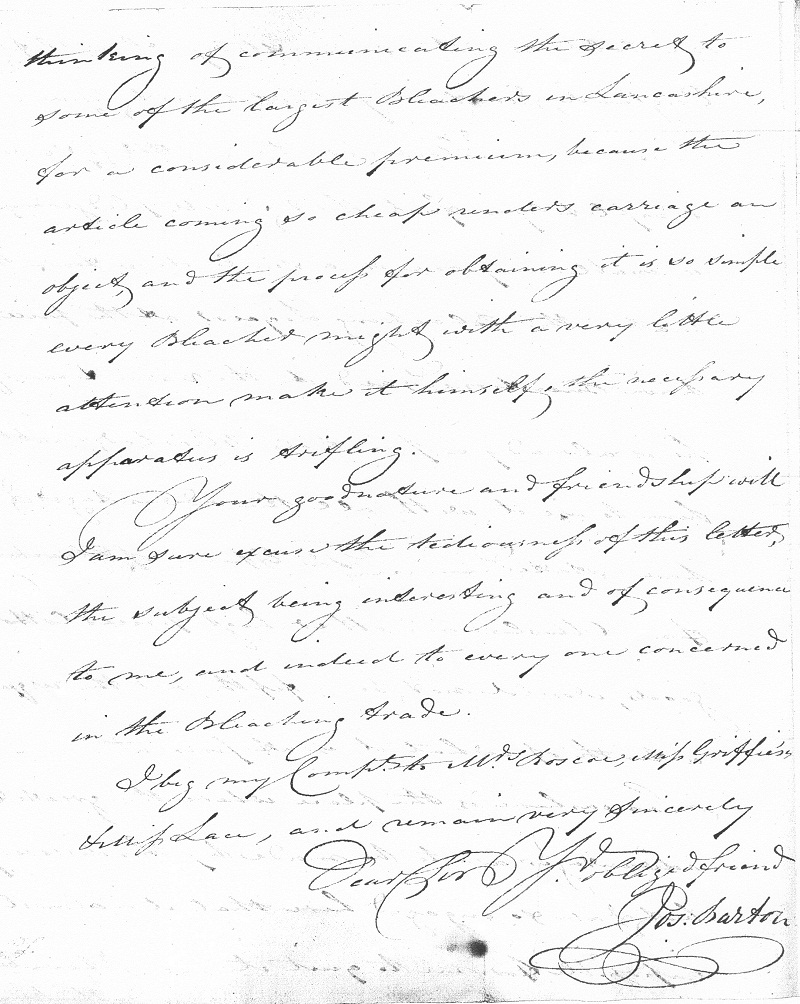
Lancashire is the place where the greatest advantages are to be made by this discovery, but I am so engaged here that it is almost impossible for me to quit it.--- I have been thinking of communicating the secret to some of the largest Bleachers in Lancashire, for a considerable premium, because the article coming so cheap renders carriage an object, and the process for obtaining it is so simple every Bleacher might with a very little attention make it himself, the necessary apparatus is trifling.
Your good nature and friendship will I am sure excuse the tediousness of this letter, the subject being interesting and of consequence to me, and indeed to every one concerned in the Bleaching trade,
I beg my Compts. To Mrs Roscoe, Miss Griffies & Miss Lace, and remain very sincerely
Dear Sir Yr. obliged friend
Jos. Barton
PS --- If your engagement will permit I would be happy in any early communication of your advice, and till something is determined on I would rather not have my name made use of.
Whatever happened to this astonishing invention? Nothing that I can find. Joseph Barton vanishes from history at this point. The History of Dundalk, and Its Environs: From the Earliest Historic Period to the Present Time (1864) by John D'Alton and James Roderick O'Flanagan (online here) mentions only one Barton: James Barton Esq. (son of this man?), and he's only a subscriber to the publication.